Medium-term Business Plan 2030
As a global comprehensive manufacturer of metalworking machinery, the AMADA Group has long supported the advancement of manufacturing for a wide range of customers. We are now transitioning to a new stage of growth to realize our long-term vision: “Transforming manufacturing challenges into strategic advantages through production innovation and advanced technology.”
Under Medium-term Business Plan 2030 announced in May 2026, we will drive forward structural reforms and growth strategies in tandem to optimize our business portfolio and strengthen our earnings base. By doing so, we will further enhance AMADA’s inherent earning power, achieve stable profit growth and improved capital efficiency over the medium to long term, and further strengthen the value we provide to shareholders and other stakeholders.
Results and Review of the Previous Medium-term Business Plan
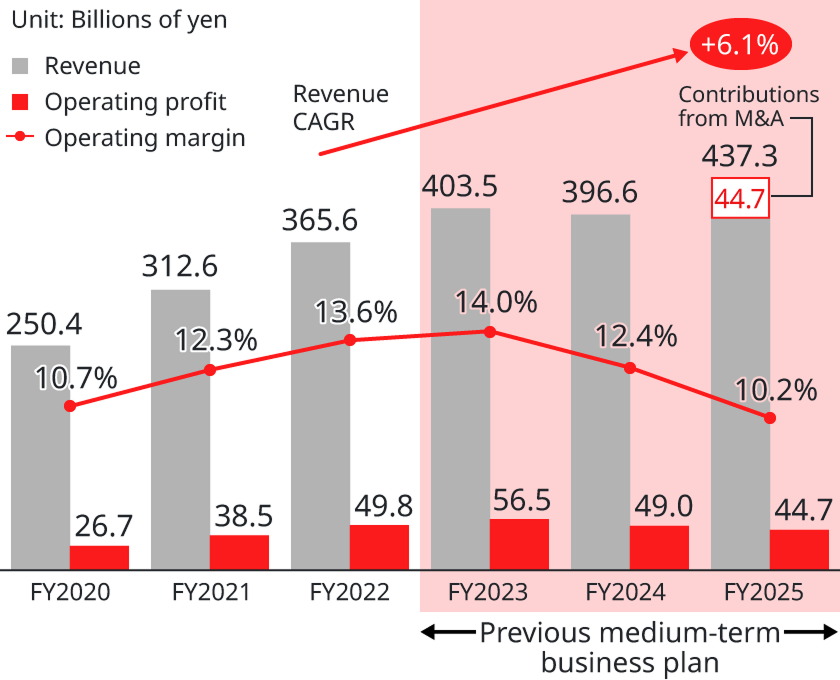
Under our previous medium-term business plan, we expanded AMADA’s business scope through M&A and achieved our revenue target. We also laid the groundwork for future growth by establishing a foundation for entering growth domains such as mobility and semiconductors, as well as strengthening our global customer relationships and technological capabilities.
However, due to delays in passing on price increases and rising material and labor costs, we fell short of our operating margin and ROE targets.
Going forward, we will leverage our expanded business foundation and make strengthening earning power as our top priority. We will enhance our earnings structure by optimizing cost through structural reforms, the clarification of earnings accountability through organizational transformation, and bundling products and services together.
Relationship Between the Long-term Vision and the Medium-term Business Plan: Roadmap
The AMADA Group positions Medium-term Business Plan 2030 as a solid foundation for realizing its long-term vision.
Under the slogan “Driving Transformation toward a New Stage of Growth,” this plan will be implemented in two main phases.
During the Transformation and Growth Phase from fiscal 2026 to 2027, we will strengthen our management foundation through structural reforms, organizational transformation, and the promotion of digital transformation (DX)., During the subsequent Acceleration of Growth Phase from fiscal 2028 to 2030, we will achieve sustainable growth by advancing portfolio management and capturing demand in growth markets.

Transformation and Growth Phase
With a focus on structural reform, we will strengthen our management foundation.
Specifically, in addition to reviewing our business structure through the optimization and reorganization of our sales, service, and production bases, we will clarify profit accountability by introducing a business unit (BU) system. Furthermore, by strengthening human capital and advancing DX, we will build an intelligent management infrastructure and lay the groundwork for our next stage of growth.
Acceleration of Growth Phase
We will leverage the management foundation strengthened during the Transformation and Growth Phase to accelerate business growth.
In addition to enhancing our value-added propositions for existing and new markets and refining our revenue structure by promoting the sales approach of shifting to a “product and service” business model, we aim to achieve sustainable growth by creating new markets through M&A and collaborations with other companies.
Targets and KPIs
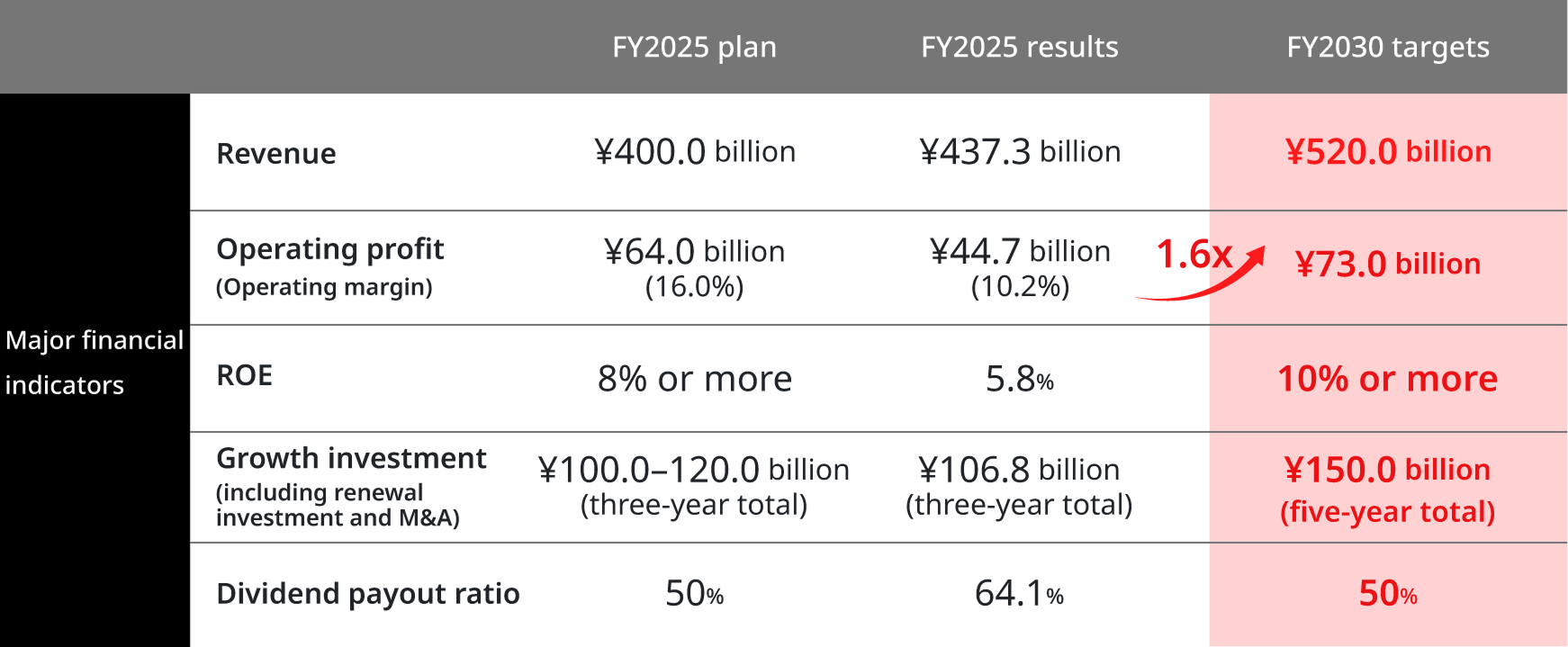
For fiscal 2030, we have set targets of ¥520 billion in revenue, ¥73 billion in operating profit, and ROE of 10% or more.
To achieve these targets, we will pursue management practices that prioritize improving profitability and capital efficiency, aiming to enhance corporate value over the medium to long term by refining our revenue structure and strengthening our earning power.
Introduction of the Business Unit (BU) System
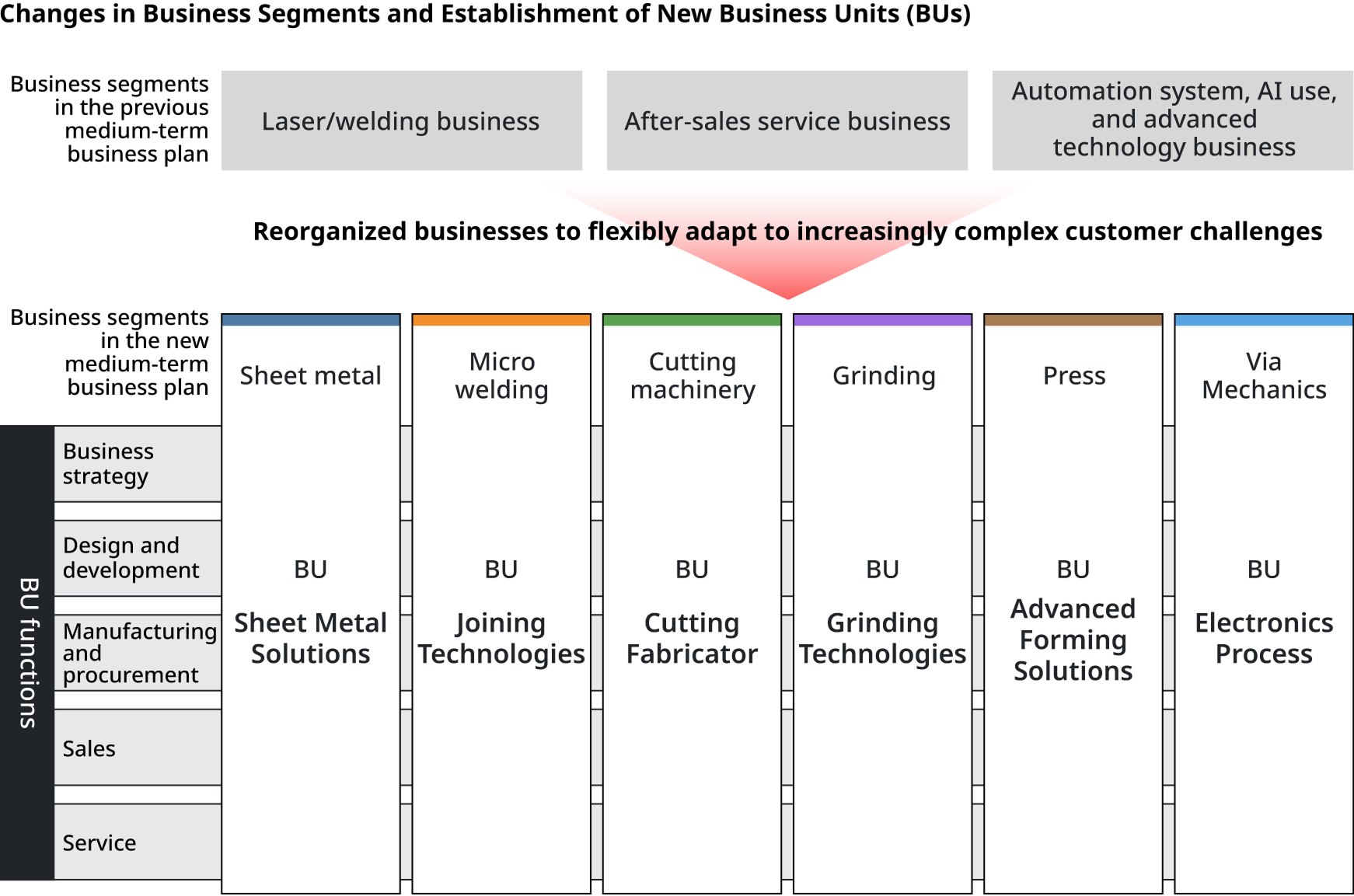
With the aim of transitioning to a business structure focused on solving customer challenges, Medium-term Business Plan 2030 introduces a new BU system.
In recent years, challenges at manufacturing sites have become increasingly complex due to labor shortages and increasingly sophisticated technologies. To respond flexibly to these changes, we have reorganized our business operations under this medium-term business plan.
Previously, our organization was managed primarily by business segment; Under this plan, we are reorganizing into BUs based on customers and markets, shifting to a structure where each BU works as a unified team to solve challenges—from formulating business strategies through design and development, manufacturing, and sales and service.
Each BU will be clearly assigned responsibility and authority from strategy formulation through execution, aiming to make profit accountability transparent and accelerate decision-making. Furthermore, by strengthening our ability to provide value tailored to each customer’s needs, we will enhance our competitiveness and improve profitability.
Through these organizational reforms, we will accelerate the shift from selling products to bundling products and services, leading to the strengthening of our earning power and the enhancement of our revenue structure.
Six Growth Strategies
To achieve the goals of our medium-term business plan, we will pursue the following six growth strategies as pillars of our activities.
-
- Structural Reform (Strengthening Earning Power)
-
- Optimizing production, sales, and service bases, improving costs and selling, general and administrative expenses
- Clarifying profit accountability through the introduction of a BU system
-
- Stronger Management Foundation
-
- Transitioning to a company with an Audit and Supervisory Committee
- Building an intelligent management infrastructure through DX
-
- Business Portfolio Management
-
- Clarifying the positioning and expected roles for each BU
- Appropriate allocation of management resources (people, assets, and capital) based on each BU’s position
-
- New Product Launches to Support Business Growth
-
- Optimizing regions, product lines, and new products through deeper marketing activities
- Entering new markets by leveraging the technical assets of each BU
-
- Business Model Transformation
-
- Pivoting the profit structure by transforming from selling products to a “product and service” business model
-
- Creation and Strengthening of New Businesses
-
- Accelerating disruptive growth through M&A and collaboration with other companies
Sustainability Strategy
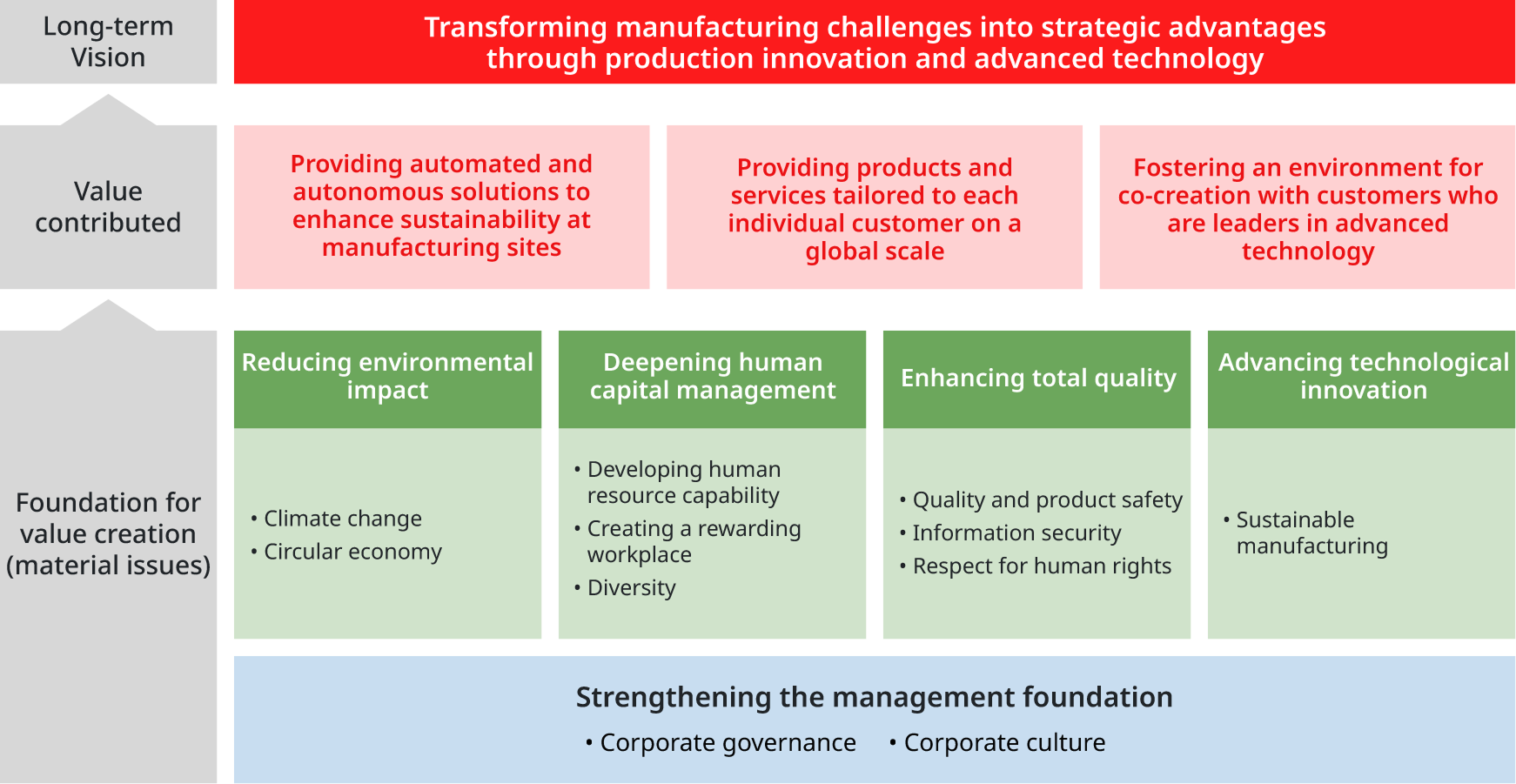
The AMADA Group views addressing social issues, such as reducing environmental impact and labor shortages, as opportunities for sustainable growth.
In addition to the reduction of CO₂ emissions through highly energy-efficient products, we support productivity improvements and labor savings by providing automation technologies.
Furthermore, as the foundation supporting these value offerings, we are strengthening our human capital and aim to provide advanced services and solutions capable of addressing increasingly complex customer challenges by developing technical human resources and expanding our educational capabilities.
Going forward, we will continue to help resolve social issues through both technology and human resources, striving to achieve a balance between enhancing our customers’ competitiveness and fostering sustainable growth.
Financial Strategy
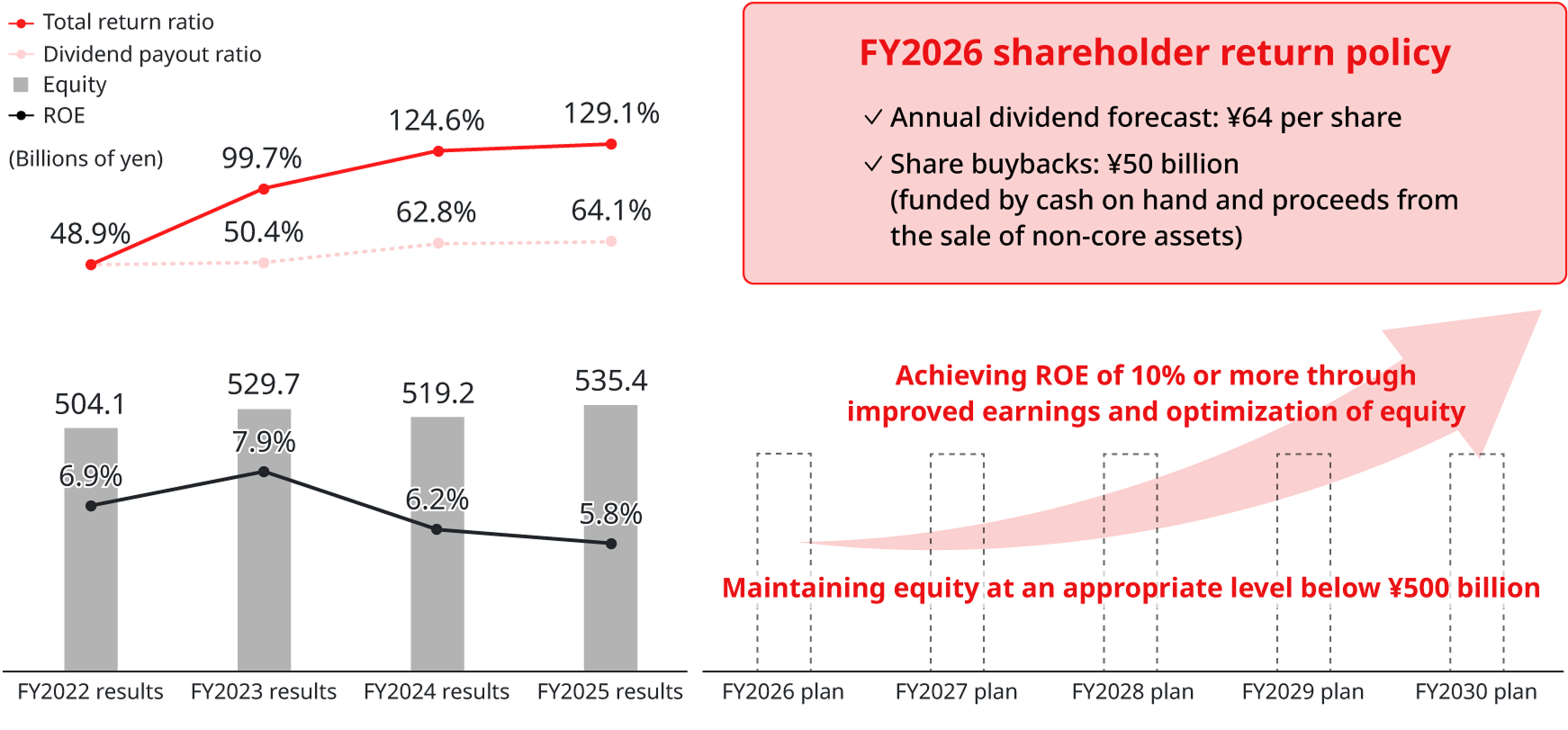
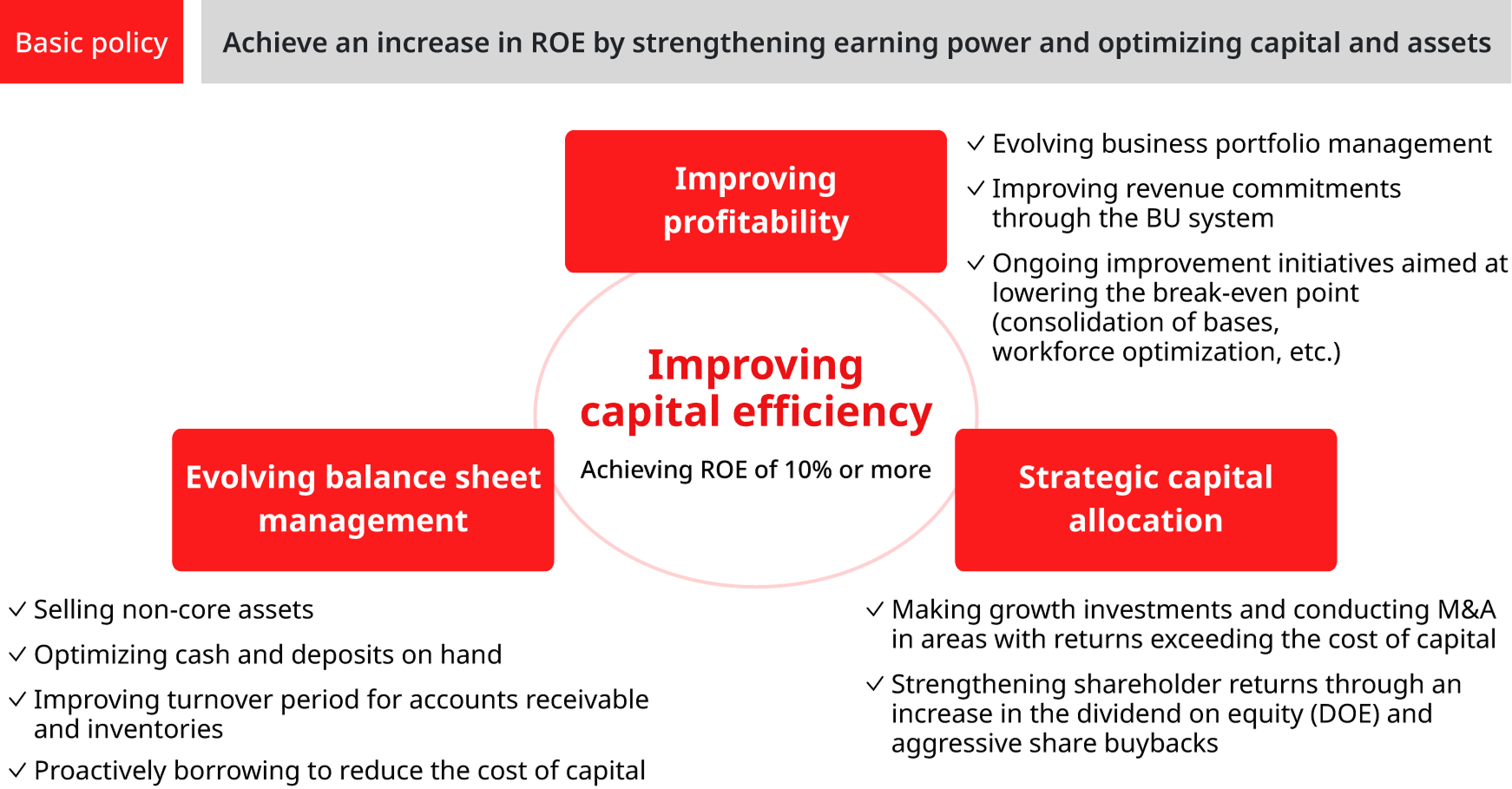
AMADA will pursue a financial strategy that prioritizes a balance between growth investments and shareholder returns, with a dual focus on strengthening our earning power and optimizing capital and assets. We see improving capital efficiency as a key indicator and will advance initiatives aimed at achieving an ROE of 10% or more, while realizing sustainable profit growth through the optimization of our business portfolio.
Investment Plan
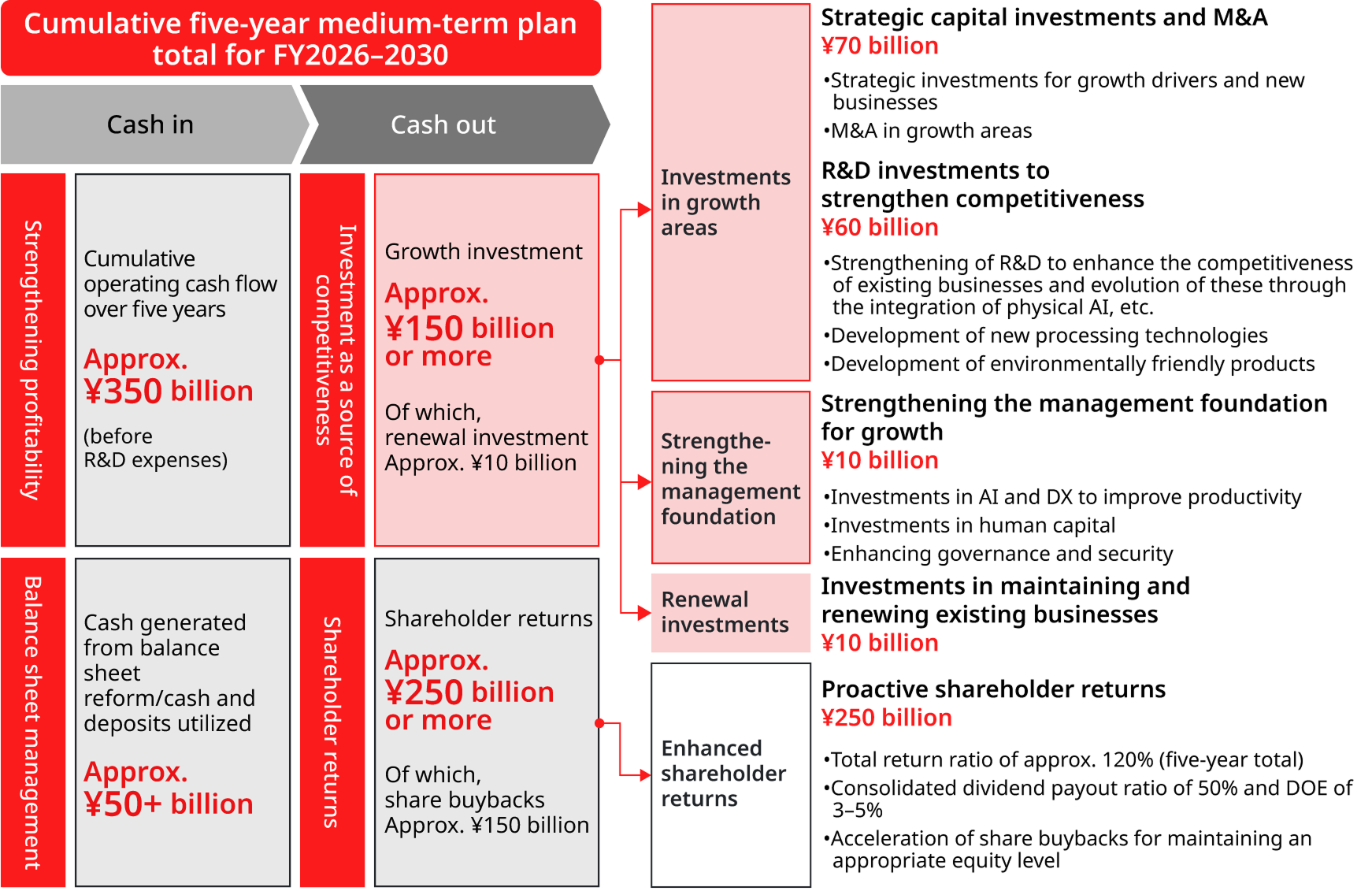
Under the current medium-term business plan, we will allocate approximately ¥350 billion in operating cash flow to be generated over five years, together with funds generated through balance sheet reforms, to growth investments and shareholder returns.
We plan to allocate at least ¥150 billion to growth investments, which will be used for capital expenditures in growth areas, M&A, R&D, upgrading production facilities, and strengthening our foundation through DX in business operations, as well as for renewal investments in existing businesses.
We expect shareholder returns to total at least ¥250 billion, which will be implemented through a combination of dividends and share buybacks.
By allocating these funds in a balanced manner, we aim to achieve sustainable growth and maximize corporate value.
Shareholder Return Policy
Our shareholder return policy is fundamentally one of stable and continuous dividends, combined with flexible share buybacks.
We will aim for a consolidated dividend payout ratio of 50% and actively return value with a total return ratio of approximately 120% (five-year total), while flexibly conducting share buybacks in consideration of appropriate equity levels.
We aim to improve capital efficiency and maximize shareholder value while maintaining a balance with growth investments.