
Materiality, KPIs and Targets
Materiality
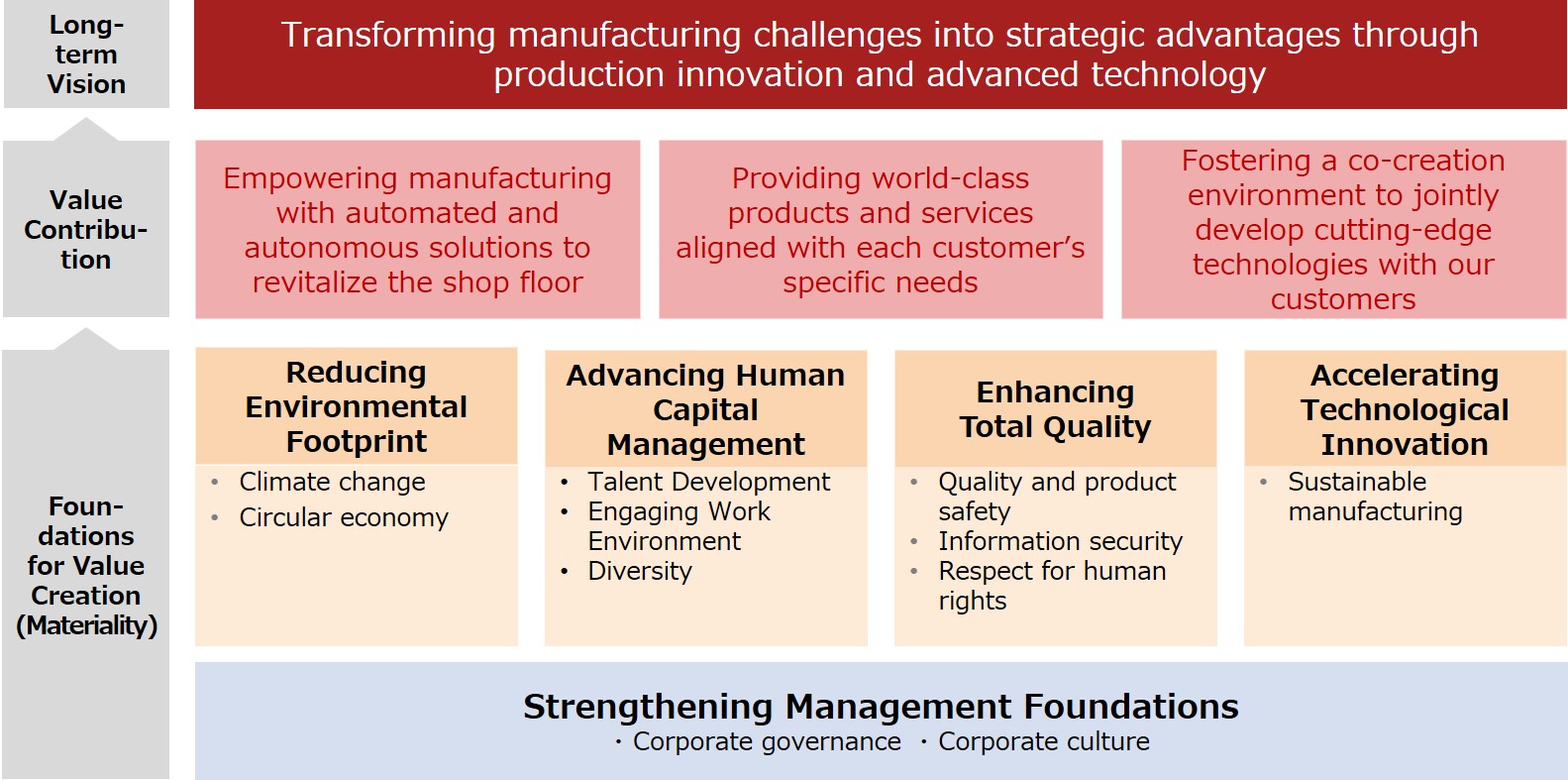
We position sustainability-related issues as a foundation for value creation to realize our Long-term Vision. In conjunction with the formulation of Medium-term Business Plan 2030, we reassessed our materiality and identified 11 material issues across five areas.
In the materiality identification process, we adopted procedures aligned with the Sustainability Disclosure Standards Board of Japan (SSBJ) Standards, taking into account domestic and international developments in sustainability disclosure regulations, and referred to various relevant guidelines. Based on these procedures, we reassessed our materiality from a double materiality perspective, considering both the impacts of the AMADA Group on the environment and society, and the financial risks and opportunities that environmental and social issues may have on the Group. For each identified material issue, we have clarified our desired outcomes and are addressing these issues in a systematic and strategic manner.
Desired Outcomes and Key Themes
The desired outcomes and key themes for each materiality are as follows.
| Area | Materiality | Desired Outcomes | Key Themes |
|---|---|---|---|
| Reducing Environmental Footprint | Climate change | Decarbonization of our operations and low-impact manufacturing | Reducing energy consumption across our facilities |
| Supporting energy efficiency and productivity improvements at customer factories | Offering environmentally responsible products and maintenance services | ||
| Circular economy | Maximizing resource efficiency through circular products and services | Building and scaling circular business models | |
| Advancing the circular economy | |||
| Advancing Human Capital Management | Talent development | Developing and securing talent to drive growth | Developing and securing business leaders, global talent, and technical experts |
| Engaging work environment | Enhancing labor productivity and employee engagement | Enhancing employee engagement | |
| Building the foundation for a safe workplace | |||
| Diversity | Fostering an inclusive and empowering workplace for diverse talent | Creating a work environment that supports employees throughout their life stages | |
| Enhancing Total Quality | Quality and product safety | Ensuring operation assurance for customers | Strengthening quality management governance |
| Information security | Ensuring business continuity across the value chain | Enhancing information security measures across the group | |
| Implementing product security measures | |||
| Respect for human rights | Contributing to a society that respects human rights | Conducting human rights due diligence across the value chain | |
| Accelerating Technological Innovation | Sustainable manufacturing | Delivering products and services that contribute to sustainable manufacturing | Standardizing technologies and optimizing resources |
| Strengthening Management Foundations | Corporate governance | Building a sound and transparent management framework | Strengthening management and oversight functions |
| Corporate culture | Fostering a sound corporate culture |
KPIs and Targets
We have established KPIs and targets to manage and evaluate progress on our material issues.
| Area | Materiality | KPIs | FY2030 targets |
|---|---|---|---|
| Reducing Environmental Footprint | Climate change | GHG emissions (Scope 1, 2) | 75% reduction |
| GHG emissions (Scope 3) | 75% reduction | ||
| Circular economy | Re-birth product growth rate | 80% or more | |
| Advancing Human Capital Management | Talent development |
• Cultivating next-generaton leaders to drive transformation • Maximizing value creation through diversity and global expertise • Co-creating customer value through the integration of technology and digital solutions |
• Expanding global leadership development programs • Developing solution-oriented engineers who address customer needs |
| Engaging work environment | Engagement score (eNPS*1) | Positive response rate improvement of 20% or more | |
| Lost-time injury frequency rate*2 | Continuous reduction | ||
| Diversity | Percentage of female managers | Continuous increase | |
| Enhancing Total Quality | Quality and product safety | Operation of a global quality assurance framework | Embedding the operational framework |
| Information security | Security maturity complaint with NIST CSF*3 | Improvement of 15% or more | |
| Respect for human rights | (Own operations) • Identification of priority human rights issues • Assessment and mitigation of human right risks • Implementation of preventive measures |
Conducting ongoing human rights due diligence | |
| (Suppliers) Sustainable procurement guideline survey score |
0% below threshold*4 | ||
| Accelerating Technological Innovation | Sustainable manufacturing | Sales growth rate in new areas*5 | 60% or more |
| Accelerating Technological Innovation | Corporate governance | Board diversity | Maintaining 50% or more external directors, with continuous improvement |
| Enhancement of the executive compensation system | Enhanced alignment with financial metrics and integration of non-financial metrics | ||
| Corporate culture | Compliance training completion rate | 1 |
Scope: The percentage of female managers covers major domestic group companies (AMADA CO., LTD., AMADA MACHINERY CO., LTD., AMADA PRESS SYSTEM CO., LTD., and AMADA TOOL CO., LTD.); the engagement score and lost-time injury frequency rate cover domestic consolidated companies; the sustainable procurement guideline survey covers major domestic suppliers. All other KPIs are reported on a group consolidated basis.
Base year: GHG emissions: FY013 (baseline: 811,635t-CO2); re-birth product growth rate: FY2024; lost-time injury frequency rate: average of FY2022-FY2024 (baseline: 0.97). All other KPIs: FY2025
- 1 eNPS: Employee Net Promoter Score
- 2 Number of lost-time injuries per one million hours worked
- 3 NIST CSF: Cybersecurity Framework of the National Institute of Standards and Technology
- 4 Threshold Score for the Sustainable Procurement Guideline Survey: 3 out of 5 points
- 5 Sales in new areas: Sales revenue generated from new and growth markets
The results of the material issues under Medium-term Business Plan 2025 are as follows:
| Theme | Indicator | Data Coverage | FY2024 | FY2025 | FY2025 |
|---|---|---|---|---|---|
| Result | Target | Result | |||
| Environment | Reduction of product CO2 emissions | Group Consolidated (vs. FY2013) | 69.1% reduction | 50% reduction | 72.5% reduction (prospective) |
| Reduction of business site CO2 emissions | 75.7% reduction | 70% reduction | 77.4% reduction (prospective) | ||
| Social | Education and training hours per employee | Major group companies in Japan* | 41.7 hours | 40 hours | 51.9 hours |
| Number of female managers | 17 | 24 | 19 | ||
| Rate of female new graduates hired | 27.6% | 25% | 26.4% | ||
| Paid leave acquisition rate | 77.1% | 80% | 82.2% | ||
| Childcare leave acquisition rate (men) | 82.5% | 70% | 86.7% | ||
| Childcare leave acquisition rate (women) | 100% | 100% | 100% | ||
| Governance | Ensuring diversity on the Board of Directors | Group Consolidated | External directors: 4 of 9 Female directors: 1 Female audit & supervisory board members: 1 |
Increase in diversity | External directors: 4 of 9 Female directors: 1 Female audit & supervisory board members: 1 |
| Review of directors’ remuneration system | Group Consolidated | Introduced stock-based compensation system linked to the medium-term business plan | Introduction of medium- to long-term incentive plan | Stock-based compensation system linked to the medium-term business plan was introduced in FY2024 |
- The major companies in Japan refer to the following four entities: AMADA CO., LTD., AMADA MACHINERY CO., LTD., AMADA PRESS SYSTEM CO., LTD., and AMADA TOOL CO., LTD.