
Business Risks
Risk management
In order to prevent and minimize any loss, the AMADA Group has established the Basic Risk Management Rules covering the basics of risk management and is striving to manage risks by, among others, examining countermeasures on a regular basis. The Internal Control and Risk Management Committee centrally manages risks the Group is exposed to and implements measures across the organization. Individual risk management is managed and handled by expert committees such as the Export Management Headquarters. In addition to the above, the risk management division set up under the Internal Control and Risk Management Committee monitors and approves the progress of risk countermeasures based on risk management sheets setting out important Group-level risks related to people, goods, money, and information. Furthermore, risk management is also addressed in a number of expert committees including the Cybersecurity Committee, the Expert Management Headquarters, the General Health and Safety Committee, and the Health Management Promotion Committee.
In the event of an emergency situation, the Group will establish an emergency headquarters and related units to undertake prompt crisis management.
Summary of risk management activities
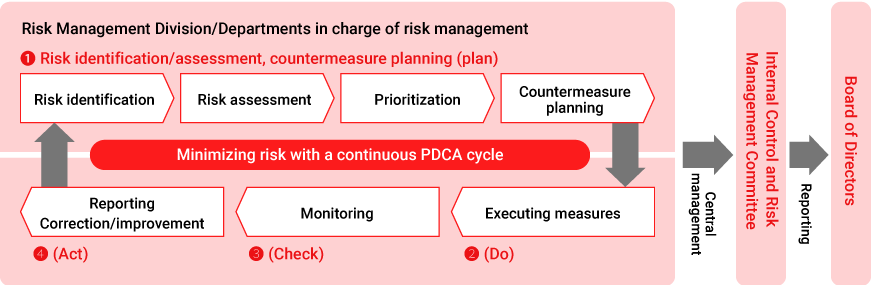
The risk management division or the department in charge of risk management reviews risks each fiscal year, reevaluating risk importance based on the size of loss and the frequency of occurrence and drafting a risk map for major risks. We will implement each risk countermeasure after clarifying the scope, targets, and deadlines for addressing major risks, and monitor the implementation status and effectiveness of the countermeasures to make necessary corrections and improvements. The Internal Control and Risk Management Committee centrally manages the identified risk items and the implementation status of their countermeasures as Companywide risk management activities and reports major risk items to the Board of Directors.
The main risks with potential impact on the AMADA Group’s operating results, financial position, or related areas are indicated below.
Please note that forward-looking items are based on judgments made by the Group as of the end of the consolidated fiscal year under review and that the items set out below therefore do not represent an exhaustive list of the risks related to the Group’s business operations.
(1) Trends in the economy and market environment
The products that the AMADA Group sells are used as production equipment for manufacturing processes in a wide range of areas, including transport equipment, home appliances, information and communication equipment, general machinery, and building materials. As a result, the Group tends to be less exposed to changes in the business climate in any one industry, but a shift in capital investment in the industry as a whole may affect its performance.
(2) Overseas development
The AMADA Group has responded to the globalization of its markets by developing production and sales bases overseas in North America, Europe, Asia and other regions. The ratio of overseas sales to total consolidated revenue for the year ended March 31, 2024 was 63.1%. As a result, there is a possibility that conflicts (wars, civil wars, coups d'état, etc.), acts of terrorism, fluctuations and changes in economic trends and the political and social environment, as well as unexpected changes to laws and regulations in countries where the Company does business or other factors could affect the Group’s operating results.
(3) Price competition
The markets where the AMADA Group is developing its business are subject to intense price competition. Although the Group strives to maintain proper sales prices by introducing new products, focusing resources on its solution proposal-type engineering business and other efforts, there is a possibility that fluctuations in sales prices as a result of increasingly aggressive or prolonged price competition could affect the Group’s operating results.
(4) Fluctuation of exchange rates
The AMADA Group exports its products mainly denominated in local currencies, including U.S. dollars and euros. The Group therefore strives to hedge exchange risk by using forward foreign exchange contracts and increasing the overseas production ratio in preparation for fluctuations in exchange rates. Moreover, as the assets, liabilities, etc., of overseas subsidiaries are translated into Japanese yen, any fluctuation of an exchange rate beyond our expectations may cause the Group to incur foreign exchange gains or losses, or change our product competitiveness, which could affect the Group’s operating results.
(5) Procurement of materials
The AMADA Group purchases parts and materials from more than one supplier. Purchase prices of these materials may fluctuate depending on changes in prices of raw materials and energy prices, including the price of crude oil. In addition, the supply and demand situation in the industry and conditions of suppliers, as well as natural disasters, may become an obstacle to the stable supply of materials, which is expected to lower our productivity and could affect the Group’s operating results.
(6) Quality of products
The AMADA Group has established a thorough quality control system based on the quality management system of the International Organization for Standardization (ISO) and strives to design and manufacture products by minimizing the occurrence of defects. In design reviews, the Group conducts risk assessment and product safety checks using prototypes. In the event of incurred recall costs due to product defects, or damages claims due to product defects resulting in an accident that is not covered by the Group’s insurance, this could affect the Group’s operating results.
(7) Addressing environmental problems
The AMADA Group works to build a production system and offer products and services that contribute to environmental preservation under its own environment policy, and strives to reduce environmental burden. The Group uses internal standards to evaluate eco-friendly products, such as resource-saving machines that use less oil and gas, low-noise machines that produce less noise, and energy-saving machines that use less electricity, and markets them as AMADA Eco-Products. Depending on environmental regulations in countries where the Group operates, however, it may be difficult to manufacture current products or use existing parts, which may result in an increase in expenses due to changes in design and R&D costs, and could affect the Group’s operating results.
(8) Intellectual property rights
The AMADA Group focuses on research and development to create new value, and files patent applications for developed technologies and know-how for the protection of intellectual property rights. However, deterioration of the Group’s competitive advantage due to a patent infringement by a third party, or any claim for damages or the suspension of sales of products resulting from a third party’s claim against the Group’s patent infringement could affect the Group’s operating results.
(9) Information Security
The AMADA group retains confidential information and personal data necessary for business operations, and strict management systems have been established to ensure the confidentiality of these assets. Nevertheless, in the event of unauthorized access caused by cyberattacks or computer viruses, our group’s operational systems could be disrupted, and confidential information or personal data could potentially be leaked externally. Such incidents may result in a loss of trust and have a negative impact on our group’s operations.
To address security risks, AMADA group has established the "Cybersecurity Committee" which conducts a continuous cycle of risk assessment, planning, implementation, and reporting as part of our efforts to strengthen IT governance at both the group and global levels. In addition, we implement education and training programs tailored to employees’ security levels to improve their security literacy. Simultaneously, as a response organization prepared for security incidents, we have established CSIRT*(Computer Security Incident Response Team) to address internal system measures. This team is maintained proactively even during times of normal operations.
*: CSIRT refers to a specialized team within the organization dedicated to improving security and responding to incidents when they occur.
(10) About Product Security
The AMADA group considers that it essential to strengthen product security to prevent significant harm or impact on our customers.
At the end, Amada committed to provide safe and secure products by adhering to both domestic and international standards for product security, such as IEC 62443.
Furthermore, we ensure that all executives, employees, and outsourced service providers involved in our products and services are fully aware of the importance of product security.
Additionally, through our PSIRT* structure, we integrate the requirements of domestic and international product security standards, guidelines, and validation methods into our product development processes.
Even after shipping, we remain dedicated to safeguard our customers' peace of mind and security by addressing product vulnerabilities and incident information promptly and effectively, thereby ensuring the security of our products.
*PSIRT: A specialized team responsible for enhancing security and responding to incidents related to the company's products and services.
(11) Natural disasters, widespread epidemics of infectious diseases
The AMADA Group operates business on a global scale via its worldwide production and sales bases. If a natural disaster such as an earthquake or flood, or a widespread epidemic of an infectious disease, inflict enormous damage on these surrounding regions where the Group operates, and if restoration and reconstruction take significant time, it could affect the Group’s operating results.
As part of its business continuity plan (BCP) measures, the Group has installed seismic isolators in some buildings at the Isehara Works and built the Disaster Prevention Energy Center to provide in-house power generation equipment, water supply, and food storage. In addition, the Group is working to diversify the risks involved in production activities and supply by promoting the expansion of its domestic and overseas manufacturing bases.
(12) Changes in the financial market
Although certain bases of the AMADA Group have introduced a cash management system to optimize interest-bearing liabilities held, a drastic rise in interest rates will increase the Group’s interest payments. Meanwhile, a decline in interest rates or fluctuations in the stock market may lower yields of securities held, change their fair values, or may affect the discount rate of plan assets to increase retirement benefit liabilities and obligations. These factors could affect the Group’s operating results.
(13) Human resources
The AMADA Group strives to recruit and develop excellent personnel engaging in manufacturing, development, and sales of the Group’s products to ensure the expansion of global business activity and maintain competitiveness. In the event that the Group fails to recruit or develop these personnel, talented employees retire, or the Group fails to retain such employees, the Group’s competitiveness may deteriorate, which could affect its operating results.
Eliminating antisocial forces
The AMADA Group states in its Corporate Code of Conduct that “we do not and will not have any connection with antisocial forces or organizations, which threaten the order and safety of civil societies, and deal with unreasonable demands with a resolute attitude and without making compromises,” and ensures that all its employees are aware of this statement.